Showing posts with label Villarceau circles. Show all posts

Wednesday, 11 November 2009

Villarceau Coils, Slinkies, and Ring-packing

Four Villarceau Coils, Eric Baird 2009Computer graphics are fine, but the problem with programming a simulation of something is that often you only get out what you put in. You lose the element of surprise. So sometimes, if you you want to find out what something really does, you build one. Available technology and spare parts permitting, of course.

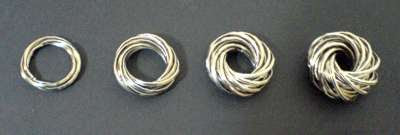
For the "Villarceau Coil" blogpost, I figured that it was worth making a physical model. A good hardware place nearby sells middle-sized keyring loops for 15 pence each, so I went in with a few quid and came away with a pocketful. Then it was just a question of clipping the things together.

There were a couple of things that I hadn't expected:

Thing Number One
was that a "keyring Villarceau coil" is a bit like a Slinky. You put it on the palm of your band, or on a flat surface, and tilt the surface, and the thing kinda ... slinks ... downhill. It reacts to the uneven pressure on its base, rings rotate and slither past each other, the torus squirms and turns inside out, and the thing scuttles off down the slope with a slightly guilty air about it, like an octopus running along a seabed.

From a science-fiction/xenobiology point of view, the coil makes an interesting template for a possible alien lifeform. With a soft toroidal body and a hard set of spiny Villarceau rings, an animal could burrow or shred predators or food by turning itself inside out. It could start as a skinny beastie with maybe three rings, and grow more rings as it got bigger and fatter. It'd solve the problem of how to reconcile a hard exoskeleton with the ability to change size. Young could be gestated as full-size rings within the fleshy body. Giving birth would probably have to be be kinda fatal, though, unless the rings each had a notch somewhere. :(

Anyhow ... Drop the coil, and it "splashes" when it lands, then reforms back to the torus shape ... or if you've used a lot of rings, into a pair of interlinked tori. You can pop it on your finger, and pass it from hand to hand, one finger at a time, by tilting your finger to point downhill towards the destination finger, so that the v-coil slinks down the finger, turning itself inside out as it goes.

So basically, a fun executive toy. Three quid well spent.

Thick Villarceau Coil, Eric Baird 2009

Thing Number Two was that the rings have a natural tendency to nest (as in, "what Russian Dolls do", not "what in birds do") .... except that, in this case, the self-similar "dolls" are all made from components that are exactly the same size. Which is a slightly wierd situation.

So if you start with maybe just three rings for a skinny torus, and you add more rings to force the thing to be fatter, you find yourself using a lot more rings than you thought. They start to form nesting toroidal layers. Since every torus that you can produce using the Villarceau configuration has exactly the same major radius as a single ring, they all fit neatly inside one another.

It's kinda reminiscent of the way that electron orbits stack up around an atomic nucleus.

And since every ring in the set of nested tori has exactly the same configuration to all the others, you can reach in and pull an inner ring and with a bit of shuggling turn it into an outer ring (while one of the outer rings shuffles back inward to take its place).

This is a FUN shape. You could probably write an entire book about it.

Friday, 30 October 2009

The Villarceau Coil

steel-ring Villarceau coil model, Eric Baird 2009
Sometimes it's fun to try to take the most ludicrously-abstract and pointless geometrical results and to try to turn them into something useful. It's a fun game, and the more abstract the thing is, the higher the chance that nobody's actually brainstormed it properly before you. The "square-cutting" exercise ended up as a possible idea for new storage media for hydrogen-powered cars, so after uploading the "Cutting up Doughnuts" post, I was scratching my head to try to think of some real-world application for the "Villarceau Circle" result, that might turn the pastry-cutting exercise into something with actual physics applications.

The best I could come up with was a variable-geometry magnetic containment device.

variable-proportion torus, showing five half-Villarceau circles
If we take our two interlocking Villarceau circles, and delete one of them, we're left with a simple ring that wraps once around the torus limb and its central void. This counts as a special-case toroidal winding. We can interleave a series of these single angled rings around the torus, intersecting, without any of them clashing or colliding. If current is circulated around each ring (perhaps by "breaking" the rings and wiring them in series), you have yourself a rather unusual toroidal coil.

What's unusual about it that it has variable geometry. Each circular ring-segment can be a rigid wound coil, and by tilting the angle of these coils we can create a larger torus with arbitrary proportions (major axis radius fixed, minor axis radius variable). Okay, so there's a limit to how fat or thin we'd be able to go due to the finite thickness of the rings that we're using to construct it, but essentially, we have something that looks like a toroidal accelerator and containment device, that can actually change shape while it's running.
Provided that the "open" configurations of the resulting toroidal coil aren't too open, this might let you prototype a device without having to calculate the ideal proportions beforehand - you'd be able to adjust the torus shape while the device was actually operating.

Now, suppose for the sake of argument that you wanted a containment device that allowed you to open it out, fire high-energy particles into it in low-energy mode, then close the coils, squash the plasma density to encourage some sort of reaction, and then open the coils again to allow the reaction products to spill out into the surrounding coolant. You could have a system that "breathes", and holds different shapes for different parts of its cycle.

Okay, I'm trying not to be too glib here – because nuclear physics is NOT my specialist field – but this thing would look awfully like a cross between the "cage fusor devices" and the "tokamak" configurations that people use for nuclear fusion. When it's closed you have something that looks like a tokamak, and when it's open you have something that looks (superficially) more like a fusor cage. One of the annoyances of the tokamak designs is that once you've built them, they're usually locked into particular configuration – with a Villarceau coil, the variable geometry means that you should be able to get some pretty significant changes in internal volume and field strength without having to vary the current flow to the coils. And if the internal pressure gets too great, the thing's going to have a tendency to self-adjust by opening out like a flower-bud, reducing internal pressure and temperature, and releasing excess plasma into the surrounding coolant in a semi-controlled way (rather than being all bottled up until things go more badly wrong).

Anyhow ... bottom line is, that even if this configuration is no damned use at all for conventional nuclear fusion, it'd still look damned cool as a piece of hardware.

Designers and art directors for science fiction movies take note. Remember how cool people though the Big Scary Spinny Machine was in Contact (1997)? Well, this configuration would be a really nice thing to use next time you have to design a cool fictional device for a spaceship reactor or engine pod. Shiny silver interlocking steel circles that tilt and swivel, with a whizzy blue plasma glow inside. Mmmm.

I want to see this cool thing in a movie NOW ! :) Who's going to be first?


PS: I did spent the last couple of weeks seriously consider building one of these as a toy, sticking it in a small vacuum chamber and whacking a high-tension voltage into it, as a version of those plasma balls that you find in gadget shops. I figured that with that, plus a set of circular coil units, and I might have a cool little device that could spin plasma (or bits of shiny silver paper) in an amusing way. I got as far as looking up coil formers. But sanity prevailed. Plus, I think my current landlord might take a dim view of his tenants trying to build small prototype nuclear fusion reactors on the premises.

Friday, 16 October 2009

Cutting up Doughnuts

An iced ring doughnut, sliced diagonallyA cool thing that I didn't know about doughnuts until someone pointed it out a few months back: no matter what proportions a doughnut has, there's always an angle that you can slice though it to produce a perfect pair of interlocking circles.

Someone mentioned this on sci.math, and pointed to "Doughnut Slicing", a webpage by John Banks and Jeff Brooks, and then, someone else pointed out that there was already a a Wikipedia article on it, under the name "Villarceau Circles" ... at which point I scooted off and tried to work the thing out from scratch, before reading anyone else's "spoilers". There's only a certain number of cool results like this, and if you read other people's work before you've had a crack at a problem yourself, that's an opportunity that you never get back.

Anyhow, it turns out that if a torus has major radius R (distance from central axis to centre of limb) and minor radius r (radius of solid limb), the magic angle A that you have to cut at to get to see the double-circle is simply

SIN A = r/R

Going back and looking at the other two webpages, it seems that, unless I missed it, the authors don't seem to have actually written that down explicitly anywhere (although they do seem to have included some more involved math).

So, one quickie download of GFA BASIC 32 (and some quickie trig) later, and the relationship's obviously right. One quick program run while my tea was cooking, generating a few hundred images of tori with radius ratios from zero to one, tilted by the appropriate angles, and I now have a sequence of pretty Villarceau images sitting on my harddrive that I'll probably string together as a YouTube animation at some point.

Villarceau Circles, Eric Baird 2009
If you want to cut up a doughnut or bagel purchased at your local bakery to see the Villarceau circles, thread a thin stick or skewer all the way through through the central hole, and then tilt it to a maximum so that your pointy-stick is touching two different parts of the surface. That line gives you the plane that you need to cut along, and the two points where your stick touches the doughnut are the two points where the pair of circles intersect.