Showing posts with label curvature. Show all posts

Monday, 6 July 2009

Projective Cosmology, and the topological failure of Einstein's General Theory

'farside black hole' projection, topological cosmology, 'Relativity in Curved Spacetime' figure 12.4
The graphic above is from my old, defunct, 1990s website, and I also borrowed it for chapter 12 of the book.

It shows a rather fun observerspace projection: if we assume that the universe is (hyper-) spherical, but we colour it in as it's seen to be rather than how we deduce it to be, expansion and Hubble shift result in a description in which things are more redshifted towards the universe's farside. Free-falling objects recede from us faster towards the apparent farside-point, as if they were falling towards some hugely massive object at the opposite end of the universe, and as if there was a corresponding gravitational field centred on the farside. At a certain distance between us and where this (apparent) gravitational field would be expected to go singular, there's a horizon (the cosmological horizon) censoring the extrapolated Big Bang singularity from view, and that looks gravitational, too.

And, funnily, enough, this "warped" worldview turns out to be defensible (as an observer-specific description) using the available optical evidence. Since we reckon that the universe is expanding, and we're seeing older epochs of the universe's history as we look further away, we're seeing those distant objects as they were in the distant past, when the universe was smaller and denser and the background gravitational field-density was greater than it is now.

Our perspective view is showing us an angled slice through space and time that really does include a gravitational gradient – between "there-and-then" and "here-and-now". The apparent gravitational differential is physically real within our observerspace projection, and viewed end-on, the projection describes a globular universe with a great big black hole at the opposite end to wherever the observer happens to be.

This projection is fascinating: it means that we end up describing cosmological-curvature effects with gravitational-curvature language, and it cuts down on the number of separate things that our universe model has to contain. If we take this topological projection seriously, some physics descriptions need to be unified. If we can agree on a single definition of relative velocity, the projection means that cosmological shifts (as a function of cosmological recession velocity) have to follow the same law as gravitational shifts (as a function of gravitational terminal velocity) ... and then, since gravitational shifts can be calculated from their associated terminal velocities as conventional motion shifts, we have have three different effects (cosmological, gravitational and velocity shifts) all demanding to be topologically transformed into one another, and all needing to obey the same laws.


This all sounds great, and at this point someone who hasn't done advanced gravitational physics will probably be anticipating the punchline – that when we work out what this unified set of laws would have to be, we find that they're the set given by Einstein's special and general theories, QED.

Except that they aren't. We don't believe that cosmological shifts obey the relationship between recession velocity and redshift supplied by special relativity.

We dealt with this by ignoring the offending geometry. Since cosmological horizons had to be leaky, and GR1915 told us (wrongly) that gravitational horizons had to give off zero radiation, we figured that these had to be two physically-irreconcilable cases, and that any approach that unified the two descriptions was therefore misguided. Since a topological re-projection couldn't be "wrong", it had to be "inappropriate". Instead of listening to the geometry and going for unification, we stuck with the current implementation of general relativity, and suspended the usual rules of topology to force a fit.

But then Stephen Hawking used quantum mechanics to argue that gravitational horizons should emit indirect radiation after all, as the projection predicts. So we'd broken geometrical laws (in a geometrical theory!) to protect an unverified physical outcome that turned out to be wrong. Where we should have been able to predict Hawking radiation across a gravitational horizon from simple topological arguments in maybe the 1930's, by using the closed-universe model and topology, we instead stuck with existing theory and had to wait until the 1970's for QM to tap us on the shoulder and point out that statistical mechanics said that we'd screwed up somewhere.

If we look at this projection, and consider the consequences, it suggests that the structure of current general relativity theory, when applied to a closed universe, doesn't give a geometrically consistent theory ... or at least, that the current theory is only "consistent" if we use the condition of internal consistency to demand that any logical or geometrical arguments that would otherwise crash the theory be suspended (making the concept almost worthless).
It basically tells us that current classical theory is a screw-up. And that's why you probably won't see this projection given in a C20th textbook on general relativity.

Tuesday, 30 June 2009

The Riemann Projection and General Relativity

The Riemann projection is associated with the mathematician Bernhard Riemann (1826-1866), and gives a method of projecting the contents of a finite spherical surface onto an infinite flat plane.

We place the sphere onto the plane, so that its South Pole is touching the surface, and then we draw lines from the North Pole to the plane. After leaving N, each line intersects one (and only one) point on the spherical surface, and one (and only one) point on the spherical plane. Every point on one on one of the two surfaces has its corresponding point on the other. As long as we don't mind making a vanishingly-small pinprick in the spherical surface at its North Pole, the two surfaces are topologically identical … we can take our pin-mark, stretch it to a finite-sized hole, and then stretch the resulting bowl-shaped surface to cover the full infinite plane.

We can also imagine this as a simple optical projection – if the sphere is a hollow transparent surface and we place a lightsource at N, then anything drawn on the sphere will project shadows onto the plane.

Einstein used the projection in his "Geometry and Experience" lecture, as an aid to visualising the idea of a closed finite universe:Riemann Sphere, Einstein, 'Geometry and Experience' lecture, 1921There's also a nice Riemann Sphere animation on YouTube, courtesy of the American Mathematical Society, and a nice image at Encyclopaedia Britannica.


Now although we don't usually want to make this sort of projection (unless we're working on something a bit abstract, like Moebius transformations), the "Riemann Sphere" projection was psychologically important for physics, because the thing was fairly easy to visualise, and because it had such far-reaching implications for geometrical physics.

Thanks to the projection, we know that any physics described in sphereland has to have an exact counterpart description in flatland, as long as we scale all our definitions to match. When we lay rulers over the surface of the sphere, rulers near the North Pole have projections onto the plane that tend towards becoming infinitely large, so the plane's surface appears (to its occupants) to be finite, just like the sphere. Similarly, a constant-speed light-pulse travelling around the sphere has a "shadow" on the plane whose speed tends to infinity as the corresponding position on the sphere approaches N . If we take objects and structures whose internal equilibrium is maintained by signals travelling at the speed of light, then as we move these objects away from S, they enlarge. So it takes us the same number of tiles to pave the infinite plane as the sphere. And to the plane's inhabitants, there's no obvious way of telling which tile is the central tile – the internal physics of the plane and sphere are precisely the same.

But the intrinsic geometry of a blank plane, on its own, is not the same as that of a sphere. We need to add something – a density-map. In order to recreate the sphere's properties , we need to either project a helpful scaling grid from the sphere onto the plane to describe how scalings need to vary across the plane's surface, or attach a value to each point on on the plane to describe the local scaling. This "density" parameter varies smoothly over the surface, so we're entitled to describe it as a field. We can then say that it's this density-field that deflects light and matter in the plane towards the region of highest density (S), by Huygens' principle. But as Newton and Einstein both pointed out, a variation in the density of an underlying medium, and the associated variation in the speed of light, can both be considered as expressions of the action of a gravitational field.

As a crude first approximation, we can say that the unscaled plane description includes a gravitational field that doesn't exist in the sphere description – and yet both descriptions are equivalent.


So ... the implication of the Riemann projection is that gravitational fields aren't absolute. We can take a physical description that works, and stretch and squash our reference-grid in weird and silly ways, and as long as we invent compensating gravitational fields that vary in sympathy with our fictitious distortions (causing space's contents to nominally stretch and squash and distort to fill exactly the same region as before), the final predictions should be identical, regardless of which grid we use.
Within a space defined by that grid, these fields are physically real. And, said Einstein, we could also run the process backwards. We can place an observer in a genuine gravitational field, and allow them freefall acceleration, and for them, that field will no longer exist in their local physics ("a freefalling observer feels no gravity"). If Eötvös' Principle (that everything falls at the same rate in a gravitational field) was right, and gravity affected everything equally, then we had to be able to produce a geometrical description of gravitational effects ... and by allowing space to be warped, we could then eliminate gravitational fields from our description as a separate effect. The background gravitational field was simply space(-time), and what we normally thought of as conventional gravity was simply the result of curvature, and of curvature-related variations in projected density.

In practice, things were a little more difficult than this: Riemann and co couldn't get their curved-space models to work using curvature in just three dimensions, so a geometrical theory of gravity had to wait until Einstein had noticed the argument for gravitational time dilation, and that it led to curvature in four dimensions.
Einstein also decided to use a "frame-based" approach, which led to some simplified geometries being cross-mapped and projected that sometimes didn't correspond to actual physics, or to the shapes that more general principles said ought to be there.

I'll deal with the topological failure of the current default version of the general theory of relativity in a future post (or two). If anyone can't wait, it's in the book.

Friday, 1 May 2009

All Physics as Curvature?

William Kingdon Clifford (1845-1879) was an Nineteenth Century mathematician and geometer commemorated by modern mathematicians by having Clifford algebra named after him. He was also a fellow of the Royal Society and The Metaphysical Society, wrote a children's book, and made the occasional cutting remark about the inadvisability of trusting the opinions of groups of experts (unless one knew for a fact that at least one of the group had personal first-hand knowledge of the thing that they were talking about).

Amongst relativists, Clifford is remembered as having been one of the first people to come out unambiguously in favour of the idea that physics could (and should) be modelled as a problem involving curved space.

In 1870, Clifford addressed the Cambridge Philosophical Society ("On the Space-theory of Matter" *), declaring:
"...
I hold in fact,
  1. That small portions of space are in fact of a nature analogous to little hills on a surface which is on the average flat; namely, that the ordinary laws of geometry are not valid in them.
  2. That this property of being curved or distorted is continually being passed on from one portion of space to another after the manner of a wave.
  3. That this variation of the curvature of space is what really happens in that phenomenon which we call the motion of matter, whether ponderable or etherial.
  4. That in the physical world nothing else takes place but this variation subject (possibly) to the law of continuity.
... "
In other words, according to Clifford, matter was simply a persistent local curvature in space. While some other well-known theorists of the time (such as Oliver Lodge) were were interested in the idea of describing matter as a sort of condensation of a presumed aetherial medium, and using ideas from fluid dynamics as a shorthand for the properties of space, Clifford considered the mathematical curvature-based descriptions as more than just a means of expressing the variation in field-effect properties associated with density-variations and distortions of an underlying medium: for Clifford, the physics was simply the geometrical curvature itself.

Clifford was one of a number of C19th mathematicians working on geometrical descriptions of physics considered as a curved-space problem, a loose association of broadly similar-minded researchers whose presentations were sometimes propagated in lectures rather than in published journal papers (and who were memorably referred to by James Clerk Maxwell as the "space-crumplers".

Clifford's view was influential, but his vision arguably wasn't quite implemented by Einstein's general theory of relativity – although GR1915 implemented curvature-based descriptions of gravitation, rotation and acceleration effects, it still fell back on an underlying flat-spacetime layer when it came to describing inertial mechanics (that layer being special relativity).

This seems to be fixable, but we're not there yet.

* "William Kingdon Clifford, Mathematical Papers", (1882) pp.21-22

Saturday, 21 March 2009

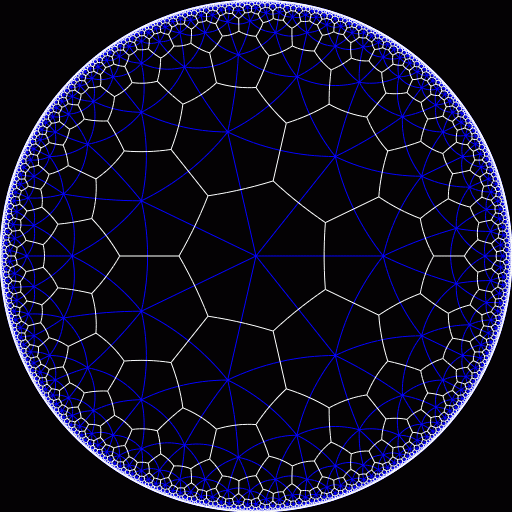
'Hyperbolic Planar Tesselations', by Don Hatch

John Baez's "This week's finds in Mathematical Physics" page often has links to math goodies. I haven't visited it for a while (where "a while" is probably measured in years), but I had a peek today, and it had a link to a site containing a whole collection of these beasties:

thumbnailof images from 'Hyperbolic Planar Tesselations' at http://www.plunk.org, by Don HatchIt's a page by Don Hatch called Hyperbolic Planar Tesselations, and it's full of links to larger versions of the pretty pictures. The image selected on the Baez page is especially nice, because it shows the tiling that you can achieve in negatively-curved space by replacing the usual flat-spacetime hexagonal tiling with heptagons. These regular tilings don't work in a flat plane. If we extrude a flat plane in one direction, then the amount of space per unit area, as judged within the plane, is less than we'd expect. If we extrude in two opposing directions (to produce a "saddle" or "pringle" shape), then as we draw larger shapes on the surface, they include progressively more area that we'd normally expect, thanks to all the folds and crinkles, and the resulting hyperbolic plane allows things like regular heptagonal tiling.

Okay, so I'm probably a sucker for tables of blue, black, and white geometrical figures, but even so, the "Don Hatch" page is really very nice. Some of the figures are reminiscent of Apollonian Net diagrams, which I'm quite fond of as fractal tiling systems, and which also in turn tend to correspond to maps of fractal-faceted solids with an infinite number of circular faces that you can achieve by continually grinding maximally-sized flat circular facets into the remaining curved surface of a truncated sphere:
Infinitely-truncated sphere, giving an infinite-sided polygon with circular faces, whose map corresponds to an Appollonian gasket
I put a quick illustrative connection map of heptagonal space on p.27 of the book ("3: Curved Space and Time"), but it was really just a crude sketch. So while my first reaction to the Hatch page was "Wow! Cool!", my second was, "Damn, I wish I'd done that".

Saturday, 14 February 2009

Curvature is Important

Curvature allows us to comprehend views of reality that can't otherwise be seen, or appreciated without an understanding of a few basic principles. Curvature allows connections and interrelationships and juxtapositions that you may find it impossible to see if you don't have the necessary mind-set.

This doesn't just apply to theoretical physics, mathematics and abstract logical structures. it also applies to real life.

Let's suppose that we're signwriters, and we have a famous department store as a client. They'd like an impressive curved sign over their main entrance, proudly displaying their name. Wouldn't it be awful if we neglected to take into account how that curved set of letters looked from different angles, and accidentally built a sign that said a Very Rude Word?

At this point you're probably remembering the fictional Great Big Sign in Douglas Adams' "Hitchhiker" series ... the one built by Sirius Cybernetics that when collapsed to half its original size, spelt out the message "Go stick your head in a pig" ... you're probably thinking that I'm about to describe some tortured hypothetical example that would never really happen in real life ... some crazy laboured combination of store name and typeface and sign geometry that would be so improbable that it'd never ever happen.

And so, sceptical reader, I invite you to examine this real-life department store sign:

T.J. Hughes store, sign, front

It's for a store called T J Hughes. Naturally, above the store's entrance we see the words T J HUGHES proudly displayed, in large red capitals. It's on a corner, and the letter sequence follows the curve.

If we turn the corner, cross the road, and look back at the sign, we still see the final “S” facing us, and to its right we see in white, slightly shrunken by perspective, the reversed white backsides of the letters H, J and T. Unfortunately, the letter J is very narrow, and the curved base of the letter is out of sight. So the J looks like an I, and although the H and T are seen reversed, they're symmetrical and still look like a perfectly normal H and T.

At this point you should be able to take a wild guess at the problem.

Here's the photo:

That's right. Seen from the right, the sign above their storefront really does say

T.J.Hughes sign, unfortunate angle, spelling out a rude word

Unfortunate, no?


This isn't a doctored photograph. The shop is real, and the sign has been there for an awfully long time. Here's the store's website, its location on Google Maps and their wikipedia entry. This really happened.

Like the title says, curvature is important. Ignore it at your peril.