Friday, 19 March 2010

Virtual Lego


Someone's finally come up with the "killer application" for VR and computer-augmented reality.

It's buying Lego.

You walk into a participating Lego shop, pick up a box of Lego, and walk over to the big screen. A video camera shows you your image. You hold out the box in front of you, horizontally, as if you're holding a tray.

The software sees the box, recognises which product it belongs to, and calculates the exact position of the box corners in three dimensions.

It then retrieves a 3D computer model of the assembled Lego model from its database, and projects a virtual reality image of the completed masterpiece onto the screen as if the completed Lego masterpiece is sitting on top of the box clutched in your little sticky hands.

You rotate the box, and on the screen, the 3D model rotates. Tilt the box and it tilts. Move the box around and you get to see the final Lego construction from different angles, complete with perspective effects.

Oh, and the computer-generated Lego image is also animated. If it's a garage, the little Lego cars scoot about, if it's a building, the little Lego people are wandering about doing their own thing, "Sims"-style, and if its a tipper truck, the truck drives about the top of the box, tipping stuff.

It's very, very cool.

Sunday, 14 March 2010

The Caltech Snowflake Site

thumbnail link image to CalTech's snowflake site, www.snowcrystals.com
While I was finishing off yesterday's snowflake post, I came across Caltech's excellent snowflake site at www.snowcrystals.com (Kenneth G. Libbrecht).

Lots of photos, lots of useful information. Caltech even have their own snowflake creation machine, that, instead of electrostatically levitating the snowflakes as they grow, or using a vertical blower, applies an electric field to grow narrow ice-spikes, and then lets the snowflakes form at the spikes' tips (which means that the central mount is probaby rigidly aligned to the resulting flake with atomic precision, and doesn't seem to affect the growing process).

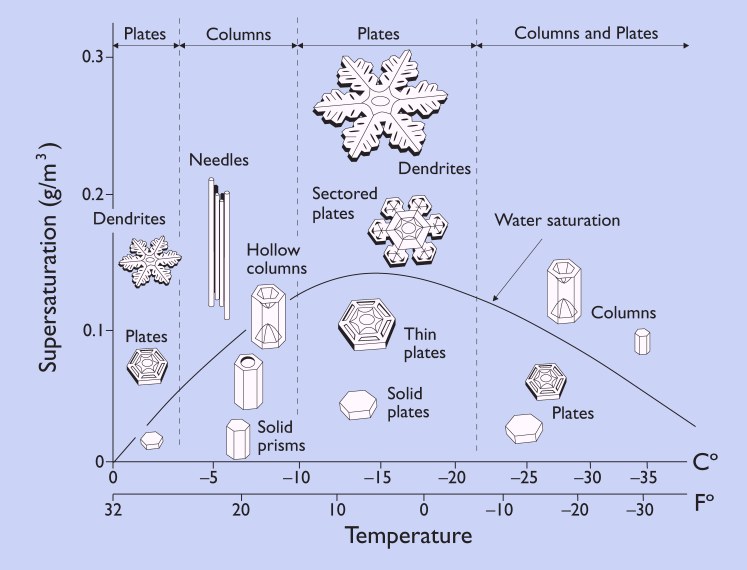
If you're in the UK, and you've mocked train companies for blaming their electrical locomotive failures on "the wrong kind of snow", well, it turns out that snow crystallisation has a slightly crazy dependency on both temperature and airborne water content, forming a range of very different shapes, from the classic branched hexagon "christmas card" forms, to hexagonal plates or long hexagonal tubes (snowflake chart).

The CalTech site explains the wide variety of snowflake forms by this temperature-dependence: the idea being that snowflakes form symmetrically because the conditions across the flake are the same at any given time, and that the extreme variety of shapes is a function of the varying environmental conditions that the whole snowflake experiences as it falls through different regions of sky. It might go through a "spiky dendrite" phase, then change temperature and start trying to grow plates, and then go back to "dendrite" mode, and the exact amount of time spent in these different phases then dictates the shape that emerges.

If the identical patterning of the arms is purely a result of the identical (varying) growing conditions across the whole flake, then we don't require any additional mechanism for regulating symmetry. In that case, we'll expect individual snowflakes to accumulate diverging asymmetries as they grow, due to gradients of temperature or water availability or light or airflow across the flake. This'd seem to make the formation of extremely regular crystals a bit unlikely.
But the CalTech site argues that actually, most natural snowflakes are pretty irregular, and that people generally overestimate the degree of symmetry because the artsy folks who photograph them (presumably including CalTech!) give a misleading impression by carefully selecting out the "best" (most regular) flakes to photograph and publish.

That explanation seems to be a bit at odds with the current suggestion of how triangular snowflakes form, though: if triangular snowflakes grow because of airflow over the flake creating an asymmetrical growing environment, breaking the hex pattern, then if there wasn't an additional internal regulating symmetry-mechanism, there'd be no obvious reason why the resulting aerodynamically-disfigured flake should have 120-degee rotational symmetry. Airflow and a moisture gradient flowing across the flake in one direction might allows a bilateral left-right symmetry for the two sides of the flake that are experiencing the same growing conditions ... it doesn't explain why the conditions at the leading point of the falling tri-flake (falling point-first) should be identical to that at the two trailing side-points, or why points on the sides of those two trailing spurs points should be equivalent, when the airflow is hitting them at different angles. If triangular flakes are due to sideways airflow, then it means that the flake seems to be fighting to retain some sort of symmetry despite significant asymmetrical disruptive forces that ought to be destroying it. That'd increase the odds of there being a significant internal symmetry mechanism in play.

Of course, it may be that our explanation of triangular snowflakes is simply wrong, that airflow isn't disrupting the hex pattern, and that instead chemical contamination (or some other factor) is causing the alternative triangular crystal structure. But that'd still mean that something in our current understanding of snowflakes is wrong or incomplete. Even if yesterday's wacky suggestion about the quantum mirage effect is midguided, we'd still not know why snowflake formation is so sensitive to environmental conditions, or what the (non-aerodynamic) explanation of triangular snowflakes might be.


So again, more research needed.


The Caltech site's debunking of "mysterious" causes of snowflake symmetry is in the "Myths and Nonsense section" at http://www.its.caltech.edu/~atomic/snowcrystals/myths/myths.htm . The page says that there aren't any special forces at work here regulating symmetry, that most snowflakes are asymmetrical and "rather ugly", and that the published examples (including the ones on the site) are atypical, because "not many people are interested in looking at the irregular ones". In other words, if you look through the published work, you get a misleading impression due to publication bias. Well, yes ... quite possibly. But since the idea of what counts as "significant" symmetry might be a bit subjective,and since the datasets aren't available for us to look at, it's difficult to take this as a definitive answer until there's been actual experimental testing done.

Water is wierd stuff, and it keeps catching us out. I remember when people used to debunk ice spikes as an obvious example of psudoscience, and now those are understood, studied, and have their own page on the CalTech site. A lot of "crazy" ideas about water do turn out to be just as dumb as they first appear, but a few turn out to be correct. The trouble is, it's not always immediately obvious which are which.

Saturday, 13 March 2010

Snowflake Engineering, Quantum Mirages and Matter-Replicators

Julia Set
One of the most impressive things about snowflakes is that we still don't really understand how they work.

We understand how conventional crystals grow – normal crystals assemble into large, faceted, regular-looking forms because the flat facets attract new atoms more weakly than the rougher, "uncompleted" parts of the structure, which provide more friendly neighbours for a new atom to bond with. So if you have an "incomplete" conventional crystal, it'll preferentially attract atoms to the sites needed to fill in the gaps, to produce a nice large-faceted shape that tries to maximise the size of its facets, as far as it can bearing in mind the original random initial distribution of seed crystals.

But snowflakes do something different. Their range of forms makes their growth appears pretty chaotic, but they also manage to be deeply symmetrical. It'd seem that the point of greatest attraction on a region of snowflake doesn't just depend on the atoms that are nearby, but also on the arrangement of atoms on a completely different part of the crystal, which might be some way away, and facing in a different direction, on a different spur. The sixfold symmetry of a snowflake suggests that when you add an atom to the point of one of the six spurs, the other five points become more attractive ... add an atom to the side of a spur, and we're dealing with twelve separate sites (twenty-four if the atom is off the plane). Add an atom to a side-branch, and a copy of the electrical-field image of that single atom is transmitted and reflected and multiplied and refocused at potentially tens of corresponding sites on the crystal surface. And that's for every atom in the crystal.

This would be beyond fibre-optics, and beyond conventional holography. It'd be multi-focus holography, and the holographically-controlled assembly of matter at atomic scales to match a source pattern – making multiple copies without destroying the original. It'd be using holographic projection to assemble multiple macroscopic structures that are atom-perfect copies of an original. And that idea should make the hairs on the back of your neck start to stand up.

The closest thing I've seen in print to this is the quantum mirage effect described in Nature, 3 Feb 2000. Researchers assembled an elliptical quantum corral of atoms on a substrate, and placed another atom at one of the ellipse's two focal points. They then examined the second focal point, and found that the atom's external field properties seemed to be projected and refocused at the second point, to give a partial "ghost" of the source atom [*][*][*]. You could interact with the ghost even though it wasn't there. Presumably your actions on the "ghost particle" copy would be transmitted back to the source, which'd be recreating the ghost behaviour by a process of electrical ventriloquism, using the elliptical reflecting wall to "throw" its voice to the ghost location.

Something similar may be happening in a perfectly-symmetrical monocrystalline snowflake as it grows. Maybe the crystal's regular structure just happens to not just split the image of the atom into multiples, but refocus them with phase coherence at all the key symmetry points. Maybe we could try adding a few metal atoms to one part of a snowflake crystal and seeing if matching atoms are preferentially attracted to the other corresponding sites.


A possible clue is the phenomenon of triangular-symmetry snowflakes.
It's been suggested that these form in nature when an asymmetrical snowflake falls corner-first, with the airflow disrupting regular hexagonal crystal formation (see also Wired). But since the remaining triangular symmetry is still so strong, this hints that perhaps the strongest linkage between crystal sites is in triples, with a secondary slightly weaker triplet attraction producing the hex.

Okay, so I suppose there might be problems in attempting to use giant snowflake crystals as matter-photocopiers ... for snowflake formation, every copied pattern forms an extension of the crystal, if you use the crystal to try to copy other things, then the "irregular" matter being copied is liable to disrupt of the focusing. You might only be able to copy layers an atom or two thick (at least, to start with).

But a giant atom-perfect monocrystalline snowflake would be an awfully fun thing to play with if you had a chip-fabrication lab with goodies like force-sensing tunnelling microscopes.

And to me, that was the one thing that could have justified building the International Space Station. The ability to build a giant, heavy-duty zero-gravity snowflake, hopefully one big and chunky enough to withstand eventually being brought back to Earth immersed in liquid helium for further study (what does Bose-Einstein condensate do when it's in in contact with a hex crystal?). That had to be worth a few billion in research money, and would have given the public something pretty to look at when it came time to tell them what the money had bought. We haven't done it yet, but maybe ...

Friday, 5 March 2010

Kylie Minogue and the Gorilla Experiment

Kylie, gorilla
To a large extent, we see and hear what we expect to see and hear. As newborns we're hit with a tidal wave of experiential data, a screaming torrent of raw sensory information that we have to learn how to deal with, and our brains' main coping strategy is to scrunch itself up until it's found ways of shutting out most of the din.

As infants, we initially lose neurons at an alarming rate until the remaining pathways can mimic (and to some extent synchronise with and predict) external datapatterns. We construct progressively more complex predictive mental models for how the outside world works, and increasingly live within our own models. We experience what we expect to experience, unless there's such a glaring mismatch that it can't be ignored.

It's a matter of data-reduction and enhanced reaction-times. We coast along, our experience being steered by sensory data but not dictated by it. If you're sitting on a chair, you don't suddenly jolt every few seconds and exclaim, "Chair!" – once the chair's been accepted you assume that it's still there until you're told otherwise. This internal secondary reality also compensates for the significant processing delays that happen in our brains – so that we think that we experience the world in real-time – by starting to react unconsciously to our internal models' predictions, before we're consciously aware of what we've seen. We live our lives from moment to moment in a state of continual anticipation.

Sometimes random data tickles our expectation-engine – when a black bin-bag blowing in the wind in the corner of an alley momentarily triggers an expectation of seeing a black cat, we don't just interpret the movement as possibly belonging to a cat, we actually see and remember the cat (until we look a second time and realise that it's just a refuse bag, and the rogue memory gets shredded).

These models act as perception filters and error-correction filters for what our brains allow us to register as reality. Information that's not compatible with the model (or not relevant) simply doesn't register on our consciousnesses, it gets stripped out as anomalous data and jettisoned before we have a chance to become fully aware of it.

The usual example for this is the basketball experiment, conducted by Daniel Simons and Christopher Chabris in the 1990s, but unfortunately, if I explain what the experiment is, it'll spoil it for you. If you don't already know about it, don't read anything else about it until you've watched this video and tried to count just the number of basketball passes made my the people in the white shirts. Then read the analysis.


The Gorilla Effect is now considered a classic, but what most psychologists might not realise is that in 1991, someone had already done a large-scale version of the experiment, using the UK's music broadcasting networks.

In '91, Kylie Minogue was still widely seen as a squeaky-clean pop songstress, freshly out of Neighbours, warbling heavily-processed Stock Aitken and Waterman lyrics over generic (and slightly cheesy) SAW chunka-chunka backing tracks.And that's when someone at the Minogue team decided to slip the f-word into one of the singles, three times, to see who noticed. Nobody did.

The single was called "Shocked" and charted at number 6.

" Shocked by the power, ooh-ohh, shocked by the power of love.
You got me fucked to my very foundations, shocked by the power, shocked by the power ..."

Whattt???

Uncharacteristically for SAW lyrics, “fucked to my very foundations” was actually a pretty great line for a pop song. Alliterative an' everything. I'd have been proud of it. And maybe that's why someone decided to leave it in.

Whether it was an ad-lib, like Atomic Kitten's alternative “You can lick my hole again” soundcheck version of their single, I don't know. But that's the version of "Shocked" that actually got broadcast, over and over again, on TV and on the radio. In a country that was obsessed with the F-word being used on music programmes, in which the Sex Pistols had made their careers by effing on Bill Grundy's show, and Jools Holland was suspended for accidentally let it slip on a live trailer for "The Tube" in 1987, and every Madonna single was eagerly being pored over by the UK press for possible naughty words or double-entendres that people could declare themselves outraged by, la Minogue got away with repeatedly standing up on Top of the Pops [a bit after ~7pm], and apparently singing her little heart out about how she was "fucked to my very foundations", three or four times per appearance, without anyone hearing it.

If you get hold of the more recent "Ultimate Kylie" compilation, the audio's different. They've either changed the recording or used a different version in which The Kylie is definitely singing "rrucked", with a pronounced "rr" rather than "fucked", with an "ff". But go back to contemporary broadcast recordings of the single ( thanks, YouTube! ), and yep – it's different.

The "Kylie" version of the gorilla experiment might be one of the biggest mass-media psychological experiments ever to take place, but unless you can get hold of contemporary recordings of radio and TV broadcasts, you might be forgiven for thinking that it never happened.

Friday, 26 February 2010

The Magic of Richard Feynman

Feynman DiagramsRichard Feynman (1918-1988) was one of the more colourful and charismatic characters in US physics.
He's remembered as one of the greatest physics minds of the Twentieth Century, which sometimes leaves non-physicists wondering exactly what it was (apart from Feynman diagrams) that he actually did to get that reputation. How did he end up being regarded as some sort of god amongst physicists, he never actually discovered anything that most people will have heard of?

One of Feynman's hobbies was stage magic. He was a keen practical joker, and was fascinated by the way that people are led to believe certain things, or why they end up acting in certain predictable ways. He was fascinated by fallibility, and predictable fallibility, which is one of the reasons why he was such a a great choice when they were picking people for the Rogers Commission, to investigate the reasons for the 1986 "Challenger" space shuttle disaster. Feynman understood the concept of system failure, both at the organisational and personal level, and he liked to play with people, including other physicists.

Stage magic often works through a process of misdirection. The practitioner demands with every element of their voice, facial gestures and body language that the audience may like to look over //here//, to the extent that we find it almost impossible not to look at their selected spot – perhaps an inch or so away from their extended, waggling fingertips – while with their other hand over //there//, they perform the mechanics of the actual trick.

A magician might announce before performing their stunt: "Look at this table. It's a perfectly ordinary table. It really, really is." And they bang on the table with their fist, and walk around it, and hit it with a stick, and mark an X on it with white chalk ... and you're concentrating so hard on the table to try to find why it's NOT an ordinary table, that you fail to notice the large black velvety cloth hanging above it, or the trap door behind it. The table is, in fact, completely ordinary. It's a double-bluff.

That's misdirection. You don't necessarily tell the audience something that's untrue or misleading, you give them a series of false clues, and let them work out the wrong story for themselves.

Another factor that makes stage magic effective is the way that people apply Occam's Razor. Technical stage tricks often require ludicrous amounts of preparation, absurd amounts of technical expertise or physical dexterity, and improbable investments in custom hardware. The assistant just happens to be double-jointed, or has an identical twin sister, or a false leg. At some subconscious level, the watcher's mind runs through a set of absurdly complicated and tortuous conspiracy theories that might explain what they're seeing and gives up, deciding that it's simpler to assume that the magician really can fly or make tigers disappear. The audience reasons that this isn't true (it's "only a trick"), but at a gut level they've already suspended disbelief enough to enjoy the show.


And so, to Feynman's magic trick.
One of the recurring stories about Richard Feynman goes something like this:
A physicist is working on a difficult problem. The physicist contacts Feynman. Feynman's secretary replies that Feynman is very busy, but could maybe schedule a meeting at some nebulous future date.
Several months pass. The physicist is contacted unexpectedly by the secretary to say that the secretary has just spotted that Mr Feynman now has a gap in his schedule, at quite short notice, and would the physicist still like to make use of it? The physicist eagerly agrees.

The physicist walks into Feynman's office.
"So,", says Feynman, "My secretary's just told me that you're working on some sort of interesting problem, but you'll have to forgive me, I've been really busy for the last couple of days, and haven't had the chance to look into it. Could you explain it to me? Oh, and could you start from scratch and make it simple, because, you know, this really isn't my field, and I'm not really up to speed with this subject. Start from the beginning."

The visitor is flattered and walks up to the board and starts explaining the nature of the problem. He pauses.

"So", says Feynman, "Let me see if I've got this right ..."

Feynman stares at the board and frantically marks symbols up while talking through what he's doing, until he has an equation.

"So your starting point would be something like that, yes? Okay, now tell me what you did next."

The visiting physicist is dumbfounded. What Feynman has just written on the board is the solution. And it's not just the solution, it's the solution to a more general version of the problem than the one that the visitor has been struggling with for months, or years. And Feynman's just done it in about three minutes flat.

The physicist leaves, ego totally destroyed, knowing that RF is in a totally different league to lesser mortals like himself.

Now, the "reveal".

If you were a suspicious stage-magician type, what you might suspect happened would be something like this: Physicist contacts RF's secretary, mentioning something about the problem. Secretary tells Feynman. RF researches the problem and all the relevant papers on the subject, and finds out how far the physicist has gotten. The secretary sends a stalling letter. Feynman adds the problem to his stack of other outstanding problems, playing them off each other, trying to cross-fertilise the different issues and bounce ideas between them, considering it a break from the problems he's actually trying to work on for himself. Finally, he works out the solution, and at this point, his secretary sends out the letter saying that RF now has an unexpected gap in his schedule.

Physicist arrives, RF plays dumb and asks them to outline the problem, RF "solves" it in three minutes flat, apparently using only the tools that the visitor has just provided.

Of course, this scenario still required RF to have been a damned good theoretical physicist. It also required RF to have had a wicked sense of humour, and to have done an awful lot of tough background work each time he pulled his stunt, just to create a few brief minutes of surprise for his "audience".

But that's exactly what stage magicians do.

Wednesday, 24 February 2010

"Relativity in Curved Spacetime", PDF eBook

'Relativity in Curved Spacetime', PDF ebook version, screenshotI've just provisionally put Relativity in Curved Spacetime online as an eBook, to see what happens. It's the full fixed-layout PDF file for the book, with an added "bookmark pane" PDF index and some annotations. If you're curious about the page layouts or you'd like a single-sheet PDF listing of the book's contents, click on the links.

I've initially priced the thing at USD $4-99, which comes out as about three quid in British Pounds. That's about a third of what Apple are going to be charging for ebooks.

If you want a nicely-bound hardcopy, and don't fancy printing off nearly 400 sides of paper, you can still buy the paperback and hardback. Otherwise, the PDF version's on Payloadz.com .

Friday, 29 January 2010

My Website Sucks

The result of adding haphazardly to a system, illustrated with a stack of mains power adaptors. Don't try this at home.
I know why it sucks ... it's not because I don't know how to write a proper website ... I do ... it's because it's a personal site, and I kinda tinker with it and add things from time to time, and experiment ... and because I've been using HTML for too long.

I was designing the site for someone else, I'd be less indulgent and more brutal with it. I'd insist that the owners had a clear brief of exactly what they wanted the site to do, and how to judge success. It'd be focused and lean and mean. I'd decide a visual theme, and a hierarchy, and apply it strictly. But when it's your own site, the tendency is to drift and add things and sections and use the pages as a sandbox for playing with different techniques until you end up with an indulgent hodge-podge of themes and style ideas that don't really gel.

If it was someone else's site, I'd tell them to delete the whole thing and start again. Don't just fiddle with the layout, start with a blank sheet of paper and a pen, doodle a brand new layout based on CSS, set up some default templates and rebuild the site from the ground up.


When you drift and add bits and pieces haphazardly, you end up slipping into old habits. I started writing webpages before we even had html tables. My first site (Erk's Relativity Pages) was a 300-page monster written entirely in Windows Notepad, and back then, a site designer had to learn all sorts of odd layout tricks (like using invisible GIFs as spacers) to produce efficient layouts. When tables were implemented by Netscape (and then by MS), we redesigned our pages to suit, with nice orderly auto-resizing panels – they were a pain to begin with, but the quirks and incompatibilities smoothed out with time, and we ended up using them everywhere. Tables became the answer to everything, from navigation panels to equation-setting. Then there was a craze for breaking a page up into sections and writing those sections as separate webpages embedded in frames. I managed to avoid that one (since I could see the long-term search-engine problems), but for a few years, using frames everywhere was supposed to be the mark of a "pro" designer. And then a couple of years later, the importance of search-engine optimisation became obvious, the fashion swung into reverse, and any frame-based sites began to look terribly dated.

Back in the 1980's and 1990's, the way to produce a flashy (but legible) site was to use a dark background with light text. The old CRT monitors tended to be strongly curved, with a display area that didn't extend quite to the edges, so a dark background made your page appear larger. With low-res CRT displays, "inverted" light-on-dark text was often easier to read, because the the outward blurring of light from the letters produced a sort of natural antialiasing effect. With dark text on pale backgrounds, the surrounding light tended to bleed over the characters, making them more difficult to read. Adding background patterning made the pages look more exciting, made the screen defects less distracting, and helped the user forget that they were staring at a fairly nasty little computer screen.

In 2010, things have flipped. Legibility isn't a problem on modern LCD displays, and because the screens are now flat, stark white rectangles actually look good. The monitor glass is thinner, so "snow blindness" due to light-scattering from large bright areas isn't so much of a problem, and you no longer need to add a faint background texture to pale or white backgrounds to disguise the "bitty" red, green and blue phosphor dots of a low-res CRT screen.

Nowadays, we practically squander space. On large screens, we use column layouts that waste most of the screen display, so that the central vertical column corresponds to what the user sees if they try to view the site from an iPhone. The web in the 1980s was content-starved, and you'd try to impress visitors with how much you had on your site and how much you could cram onto a small screen. In 2010 the visitor is spoilt for choice, so now designers try to keep things minimal and direct their visitors as quickly as possible to the information they actually want, otherwise they'll just click back to Google and try somewhere else.

After tables and frames, we now have Cascading Style Sheets. CSS is genuinely cool, and I really ought to rip up the existing pages and redo all their elderly table-based layout completely using CSS. Trouble is, it'll require a certain amount of work, and the immediate result will be that certain existing things (like same-height panels) won't work so well. There are bodges and workarounds, CSS isn't quite perfect yet.

The site's "look" also badly needs an overhaul. It was originally going to just be a few pages supporting the book, with a navy blue block across the top and down the left side referring to the book cover art (front and spine). On the subsequent pages, that morphed into a "program window" theme, with a title bar and an icon in the top left corner. I never quite worked out what to do with the spine. It's now an inconsistent mess, with pages on almost unrelated subjects like fractals, and should really be torn down and rebuilt.


Relativity theory is in a similar mess. A number of themes have come and gone, and left their mark on the subject. There are artefacts and traditions in the way that theory is presented that don't really make sense in the new context, and older methods that aren't compatible with newer principles. We teach special relativity as having destroyed aether theory, but we still teach SR using the length-contraction idea, which was an old aether theory concept borrowed from Lorentzian electrodynamics.

In theoretical physics, we probably have a feeling deep down that we know that we really ought to be tearing up the current system and starting again. But it'd require a lot of work without an immediate payoff, and some of the things we currently do would stop working for a while as the new system found its feet. The current system is bodgy and patched and held together with string and duct tape, but we know how to use it, and over time the bugs and fudges have started to feel like old friends. We invested a lot of time in special relativity (like website designers spent a lot of time learning the quirks of HTML tables), and now that we know that system, we tend to use it everywhere. With special relativity, we've gone further and actually redefined some key parts of relativity theory in such a way as to make SR inevitable and unavoidable, and this lock-in frees us from having to make awkward upgrade decisions.

So while it may seem that I'm sometimes a bit harsh on the theoretical physics community for being welded to obsolete and archaic systems that don't really make sense in the C21st, I do actually sympathise and empathise with their problem. They ought to rip up their SR-based structure and redesign, just as I ought to rip up my table-based webpage layout and redesign. But there's a difference between knowing that you ought to do something, and actually rolling up your sleeves and starting work, especially when there's no external deadline forcing your hand, and you always seem to have other more pressing things demanding your time.

So to help the theoretical physics community, here's a time-point. The book came out in late 2007, and sketches out the principles and the rough shape of the suggested next-generation replacement for our current general theory of relativity. This is early 2010, and the book's now been out for two years. That book is the roadmap to what comes next. So perhaps we can have a concerted start on plotting out at least a rough preliminary schedule for a replacement to general relativity, some time in 2010?

Meanwhile, I'll try to think of a way of cleaning up the website.

Friday, 22 January 2010

Einstein's Cosmological Constant

LambdaBack in 1916, Einstein was still working to the assumption that the universe should be neat and tidy, and since he was now using a more mathematical approach, this meant "infinite and unchanging".
If you were solving the equations of general relativity, and getting solutions in which the universe appeared to be unstable, then you could throw those away. Chaos was bad. Order was good. Stability was good. Static solutions were better than dynamic ones.

Since it seems that gravitational mass is always positive, gravitational effects are cumulative, and over a large enough region, the combined background curvature should be enough to curve space right back on itself. The combined attraction also ought to be trying to make the universe contract, so we've appreciated for a while that unless there was some other effect in play, the universe should either be expanding and slowing, or collapsing in on itself (see: Erasmus Darwin, 1791).

Einstein wanted his universe to be pretty much flat at very large scales, so he got rid of the effects caused by cumulative curvature by adding an additional squiggle to the equations: an invented long-range repulsive effect whose purpose was to counteract the cumulative long-range effects of gravitation, allowing a tidy, constant, unchanging, static universe. If the rest of the equation generated long-range curvature effects and evolution over time, the upper-case Greek letter Lambda (Ī›) represented the necessary compensating effect that might exactly cancel these effects.

Einstein referred to this as the Cosmological Constant.

Unfortunately, Einstein had made his model too tidy. A few years later, Edwin Hubble successfully measured a distance-dependent trend in the spectral shifts of light from a range of galaxies (Hubble shift), and we realised that the complicating large-scale effects that Einstein thought he'd eliminated with his Cosmological Constant seemed to be physically real. After taking some time to think the matter over, Einstein agreed that a Riemann-type solution (without Lambda) gave a cleaner and more natural implementation of General Relativity. He later described his early decision to invent the Constant to force large-scale flatness onto GR as "The biggest blunder of my career".

End of story.


However, the subject seemed to kick off again in the 1990's when a lot of headlines started appearing in in the popular science press (and in scientific papers) to do with the idea of dark energy, and the idea that the universe seemed to be expanding faster than GR1915 predicted – these articles usually declared that "Einstein's Cosmological Constant" was back, and had excited-sounding researchers competing to see who could give the best quote about Einstein having been "right all along".

This wasn't really true: Einstein's Cosmological Constant had been a mathematically-derived thing that only had one allowable value, and whose justification was to set the strengths of a range of effects in the model (large-scale curvature, distance-dependent redshifts, change in size over time) to zero. It had been there for purely logical reasons, in the context of a static universe, because a static universe seemed to need it. It existed to explain an assumed physical equilibrium that turned out not to exist, in a universe that wasn't ours. It was derived from bad assumptions, but at least it was derived.

The modern counterpart was almost the opposite. The antigravitational "dark energy" cosmological constant applied to an expanding universe that seemed to be expanding too fast for GR1915, and the effect initially had no fundamental logical, mathematical, geometrical or theoretical basis. It was, essentially, a parameter describing the extent to which the result of our GR predictions "missed" the actual data.
More recently, some researchers have tried to put the dark energy idea onto a more "theoretical" footing by arguing that perhaps the constant might not have a fixed arbitrary value, but might be a measure of the universe's expansion. That'd make the "modern" CC less fudgey, but it'd also mean that, as well as the thing not being Einstein's, it wouldn't be a constant, either.

So why did we initially get all those news stories announcing things like: "Eighty years later, it turns out that Einstein may have been right ... So he was smarter than he gave himself credit for." [*] ?

Putting it brutally, it was about PR. Attaching Einstein's name gave a false sense of historical provenance and a false sense of respectability. It let researchers use Einstein's name as a shield to deflect awkward questions about the apparent arbitrariness of their new expansion effect, and it turned a fairly boring and slightly negative story about GR failing to agree with the evidence into a snappy human-interest story about the throes of the scientific process coming out right in the end, and Einstein being right, and GR being right.

The "Einstein's Cosmological Constant returns: Einstein was right after all!" stories generated a lot of news headlines, and let researchers give interviews to magazines and appear on the telly and improve their departments' media profiles. Suddenly there were a lot of editors and journalists wanting quotes on the cosmological constant, because they wanted to print the same reader-grabbing "Einsteiney" headline, but didn't want to put their name on the claim, as reporters, because it was dodgy. So they rang round the universities and found a bunch of cosmologists happy to give the right quote if it meant getting their name in a magazine or getting onto the telly.

The story was junk. It was researchers collectively gaming the news media, and manufacturing and repeating a story that they knew would work, in order to get more media exposure. And unfortunately, that's the sort of behaviour that makes the general public more inclined to distrust scientists.

Friday, 15 January 2010

Clever, Bright, and Smart

There's no single scale that adequately describes someone's abilities. People can excel at some types of task and be hopeless at others, and we have a range of different words for different types of aptitude.

Three of the most popular ones are clever, bright and smart.

Cleverness is about tool manipulation. It's about having a library of information and methods at your disposal that you can call upon to attack a problem. It's about the toolset. "Clever" researchers tend to be great at solving well-known types of problems, or well-defined problems that are attackable with existing approaches. It's a matter of going through the toolset until you find something that works. Clever people tend to be good at technical subjects that involve absorbing a lot of jargon and detail. They're not always so good at solving or understanding problems that aren't well defined, or seeing the bigger picture, or starting with a blank page.

Brightness is about being able to appreciate larger patterns and relationships that don't necessarily conform to an existing approach or definition. Bright people tend not to be so dependent on clearly-defined goals or methodology, and can take a more "free-form" approach to work, where the project parameters and characteristics emerge as the project progresses.
A computer programmer needs to be clever, but a software designer needs to be bright.

"Clever vs. Bright" is like comparing soldier ants with butterflies. The soldier ant, working with other soldier ants, manages to overcome a lot of problems even if each individual ant doesn't really know where they fit into the larger scheme of things. The butterfly arguably has the better world-view, but can't always do very much with it.

Smartness is about being able to understand and exploit opportunities to gain advantage and achieve goals. It's possible to be clever and bright without being smart. Having "smarts" means that you learn from experience and think ahead strategically, to plan how the workings of a system can allow you to achieve your desired outcome.

Smart people are often also bright and clever, but they're also smart enough to realise that their success doesn't depend on cultivating those other skills to the same extent, because once they've become moderately successful, they can "hire in" clever and bright people to do that part of the work, and delegate. Successful entrepreneurs tend to be smart, and bright, and clever, but their focus is on being smart.
Military R+D usually wants researchers who are extremely clever, but not necessarily too bright or smart. A "bright" employee might query what their work is to be used for, notice how their research fits together with others to produce a device that they aren't supposed to know about, or query the legality or ethics or consequences of the project they're involved in. A smart researcher might realise that the market value of their work is more than their current employer is paying, leave to take a better job when they realise that the project is in trouble, or try to wrest control of the project from the existing managers.


Now, this is where it gets complicated:

People who describe themselves as smart (outside a limited peer group) usually aren't.
Smart people tend not to publicly identify themselves as as smart, because it's usually not a smart thing to do. Clever people sometimes describe themselves as smart, because nobody's actually told them what the words mean, and they're not bright enough to work it out for themselves. They follow the lead of the other clever people in their group that they've heard describing themselves as smart. The bright people also don't normally describe themselves as smart, because they only hear the word being used self-referentially by people with poor social skills who are "clever-only", and they decide that they don't want to be lumped in with them.

So if you're studying monkeys in a zoo that are picking grubs out of a log that have been put there by the zookeeper, the clever monkey will become adept at using a stick to extract the grubs, the bright monkey will watch the zookeeper and only go grub-hunting when the log's just been refilled, and the smart monkey will congratulate the other two on their cleverness, assume a management position and a share of the grubs, and then patent the stick.

Different skills.

Thursday, 7 January 2010

Relativity Four Point Zero

'4.0'logo and icon for the 'Relativity four point zero' website (www.fourpointzero.org)Okay, here starts a new decade. I've started a simple site sketching out the basic principles of the suggested revised general theory:

I figured that if the work of Galileo & Newton counts as "Relativity v1.0", special relativity changed some key equations and counts as v2.0, general relativity altered and added some fundamental principles and did away with SR's concept of global lightspeed constancy, and therefore counts as v3.0, then since this isn't compatible with the current textbook definitions of GR (because it eliminates the "compulsory" SR component), it counts as another "discontinuous" iteration and earns a further major version number, 4.0 .

You can't get to 4.0 without breaking a few eggs. That's what makes it 4.0 .

I was thinking of giving the new site ~twenty-six sections listed in alphabetical order, one page per letter, but I think I might just stop at five or six (the current pages A-E seem to work quite well as a logical progression). I'm trying not to fall into my usual trap of writing realms of material that most people won't want to read, and keeping things pretty minimalist, so there's a lot of the more juicy stuff left out. I think this sort of "skeleton" overview probably serves a useful purpose, so don't expect a lot of updates to the "4.0 org" site, unless other people get involved.

Thursday, 31 December 2009

New Year's Eve

'THIS IS THE END OF THE BEGINNING': Final image from George Pal's 'Destination Moon' (1950)Okay, that's it. First decade of the new century over, and we've got almost nothing good to show for it, physics-wise.
That's bad. We only get ten of these per century. One down, only another nine to go before 2100. If we're burning through resources at the current rate, we can't afford to waste decades like this if we want to actually achieve something significant this century before we get hit by a resources crash.

So a suggested schedule. Let's officially notice the idea of a no-floor implementation of GR by at least late 2010, and see if we can get rid of dark matter and dark energy. Let's have the quantum gravity guys working on acoustic metrics as a low-velocity approximation have the guts to come out and actually suggest that this might be the basis of a real theory, and not just a toy model. Let's stop issuing press releases claiming that the current version of general relativity is the wonderfullest theory and has never ever failed us, let's acknowledge the problems and let's sit down and write a proper general theory from scratch, stealing that "acoustic metric" work.

Instead of setting a schedule that puts the next theoretical breakthroughs maybe eighty or a hundred years from now because we aren't clever enough to understand string theory, let's get off our arses and do the things that we do know how to do. Kick off with the no-floor approach, and when we're energised by the success of that, converge the acoustic metric work with a GR rewrite .. and suddenly the next generation of theory only looks about five years away. If we're very lucky, two and a half. If we can't get enough people onboard fast enough, maybe eight to ten.

Unless we take that first step of exploring the idea that change might be possible and might be a good thing, we won't get anywhere except by dumb luck and/or massive public spending on hardware. If we're not careful, and we don't change the way we do things, next thing we know it'll be 2020 and we still won't have achieved anything.

So let's write off the 00's as a big double-zero. Let's pretend that the Bush years and Iraq and the financial crash never happened. We don't need multi-billion-dollar hardware for this, we only need to be able to think, and to be a bit more adventurous than we've been for the last few decades. Lets redo general relativity properly and get a theory that we can be proud of without having to spin results, one that actually predicts new effects in advance rather than retrospectively, and has the potential to lead us into genuinely new physics territory.

Tomorrow is 2010. Let's start again.

Wednesday, 30 December 2009

Differential Expansion, Dark Matter and Energy, and Voids

2df Galaxy Redshift SurveyA raspberry (NASA: Pinwheel galaxy
Normally with a field theory, you have some idea where to start. You start by defining the shape and other properties of your "landscape" space, and then you add your field to that context, and watch what it does when you play with it.
But in a general theory of relativity (which is forced by Mach's Principle to also be a relativistic theory of gravity), the gravitational field is space. The field doesn't sit inside a background metric, it is the background metric.
So with this sort of model, we've got no obvious starting point – no obvious starting geometry, and not even an obvious starting topology, unless we start cheating and putting in some critical parameters by hand, according to what we believe to be the correct values.

We make an exasperated noise and throw in a quick idealisation. We say that we're going to suppose that matter is pretty smoothly and evenly distributed through the universe (which sounds kinda reasonable), and then we use this assumption of a homogeneous distribution to argue that there must therefore be a fairly constant background field. That then gives us a convenient smooth, regular background shape that we can use as a backdrop, before we start adding features like individual stars, and galaxies.

That background level gives us our assumed gravitational floor.

We know that this idea isn't really true, but it's convenient. Wheeler and others tried exploring different approaches that might allow us to do general relativity without these sorts of starting simplifications (e.g. the pregeometry idea), but while a "pregeometrical" approach let us play with deeper arguments that didn't rely on any particular assumed geometrical reduction, getting from first principles to new, rigorous predictions was difficult.
So while general relativity in theory has no prior geometry and is a completely free-standing system, in practice we tend to implicitly assume a default initial dimensionality and a default baseline background reference rate of timeflow, before we start populating our test regions with objects. We allow things to age more slowly than the baseline rate when they're in a more intense gravitational field, but we assume that the things can't be persuaded to age more quickly than the assumed background rate (and that signals can't travel faster than the associated background speed of light) without introducing "naughty" hypothetical negative gravitational fields (ref: Positive Energy Theorem).
This is one of the reasons why we've made almost no progress in warpdrive theory over half a century – our theorems are based on the implicit assumption of a "flat floor", and this makes any meaningful attempt to look at the problem of metric engineering almost impossible.

Now to be fair, GR textbooks are often quite open about the fact that a homogeneous background is a bit of a kludge. It's a pragmatic step – if you're going to calculate, you usually need somewhere to start, and assuming a homogeneous background (without defining exactly what degree of clumpiness counts as "homogeneous") is a handy place to start.


But when we make an arbitrary assumption in mathematical physics, we're supposed to go back at some point and sanity-check how that decision might have affected the outcome. We're meant to check the dependencies between our initial simplifying assumptions and the effects that we predicted from our model, to see if there's any linkage.
So ... what happens if we throw away our "gravitational floor" comfort-blanket and allow the universe to be a wild and crazy place with no floor? What happens if we try to "do" GR without a safety net? It's a vertigo-inducing concept, and a few "crazy" things happen:

Result 1: Different regional expansion rates, and lobing
Without the assumption of a "floor", there's no single globally-fixed expansion rate for the universe. Different regions with different "perimeter" properties can expand at different rates. If one region starts out being fractionally less densely populated than another, its rate of entropic timeflow will be fractionally greater, the expansion rate of the region (which links in to rate of change of entropy) will be fractionally faster, and the tiny initial difference gets exaggerated. It's a positive-feedback inflation effect. The faster-expanding region gets more rarefied, its massenergy-density drops, the background web of light-signals increasingly deflects around the region rather than going through it, massenergy gets expelled from the region's perimeter, and even light loses energy while trying to enter, as it fights "uphill" against the gradient and gets redshifted by the accelerated local expansion. The accelerated expansion pushes thermodynamics further in the direction of exothermic rather than endothermic reactions, and time runs faster. Faster timeflow gives faster expansion, and faster expansion gives faster timeflow.

The process is like watching the weak spot on an over-inflated bicycle inner tube – once the trend has started, the initial near-equilibrium collapses, and the less-dense region balloons out to form a lobe. Once a lobe has matured into something sufficiently larger than its connection region, it starts to look to any remaining inhabitants like its own little hyperspherical universe. Any remaining stars caught in a lobe could appear to us to be significantly older than the nominal age of the universe as seen from "here and now", because more time has elapsed in the more rarefied lobed region. The age of the universe, measured in 4-coordinates as a distance between the 3D "now-surface" and the nominal location of the big bang (the radial cosmological time coordinate, referred to as "
a" in MTW's "Gravitation",§17.9), is greater at their position than it is at ours.

With a "no-floor" implementation of general relativity, the universe's shape isn't a nice sphere with surface crinkles, like an orange, it's a multiply-lobed shape rather more like a
raspberry, with most of the matter nestling in the deep creases between adjacent lobes (book, §17.11). If there was no floor, we'd expect galaxies to align in three dimensions as a network of sheets that form the boundary walls that lie between the faster-expanding voids.

And if we look at our painstakingly-plotted maps of galaxy distributions, that's pretty much what seems to be happening.

Result 2: Galactic rotation curves
If the average background field intensity drops away when we leave a galaxy, to less than the calculated "floor" level, then the region of space between galaxies is, in a sense, more "fluid". These regions end up with greater signal-transmission speeds and weaker connectivity than we'd expect by assuming a simple "floor". The inertial coupling between galaxies and their outside environments becomes weaker, and the influence of a galaxy's own matter on its other parts becomes proportionally stronger. It's difficult to get outside our own galaxy to do comparative tests, but we can watch what happens around the edges of other rotating galaxies where the transition should be starting to happen, and we can see what appears to be the effect in action.

In standard Newtonian physics (and "flat-floor" GR), this doesn't happen. A rotating galaxy obeys conventional orbital mechanics, and stars at the outer rim have to circle more slowly than those further in if they're not going to be thrown right out of the galaxy. So, if you have a rotating galaxy with persistent "arm" structures, the outer end of the arm needs to be rotating more slowly, which means that the arm's rim trails behind more and more over time. This "lagging behind" effect stretches local clumps into elongated arms, and then twists those arms into a spiral formation.
When we compare our photographs of spiral-arm galaxies with what the theory predicts, we find that ... they have the wrong spiral. The outer edges aren't wound up as much as "flat-floor" theory predicts, and the outer ends of the arms, although they're definitely lagged, seem to be circling faster than ought to be possible.

So something seemed to be wrong (or missing) with "flat-floor" theory. We could try to force the theory to agree with the galaxy photographs by tinkering with the inverse square law for gravity (which is a little difficult, but there have been suggestions based on variable dimensionality and string theory, or MOND), or we could fiddle with the equations of motion, or we could try to find some way to make gravity weaker outside a galaxy, or stronger inside.

The current "popular" approach is to assume that current GR and the "background floor" approach are both correct, and to conclude that there therefore has to be something else helping a galaxy's parts to cling together – by piling on extra local gravitation, we might be able to "splint" the arms to give them enough additional internal cohesiveness to stay together.

Trouble is, this approach would require so
much extra gravity that we end up having to invent a whole new substance – dark matter – to go with it.
We have no idea what this invented "dark matter"might be, or why it might be there, or what useful theoretical function it might perform, other than making our current calculations come out right. It has no theoretical basis or purpose other than to force the current GR calculations to make a better fit to the photographs. Its only real properties are that its distribution shadows that of "normal" matter, it has gravity, and ... we can't see it or measure it independently.

So it'd
seem that the whole point of the "dark matter" idea is just to recreate the same results that we'd have gotten anyway by "losing the floor".

Result 3: Enhanced overall expansion
Because the voids are now expanding faster than the intervening regions, the overall expansion rate of the universe is greater, and ... as seen from within the galactic regions ... the expansion seems faster than we could explain if we extrapolated a galaxy-dweller's sense of local floor out to the vast voids between galaxies. To someone inside a galaxy, applying the "homogeneous universe" idealisation too literally, this overall expansion can't be explained unless there's some additional long-range, negatively-gravitating field pushing everything apart.

So again, the current "popular" approach is to invent another new thing to explain the disagreement between our current "flat-floor" calculations and actual observations.
This one, we call "Dark Energy", and again, it seem to be another back-door way to recreating the results we'd get by losing the assumed gravitational background floor.

So here's the funny thing. We know that the assumption of a "homogenous" universe is iffy. Matter is not evenly spread throughout the universe as a smooth mist of individual atoms. It's clumped into stars and planets, which are clumped into star systems, which are clumped into galaxies. Galaxies are ordered into larger void-surrounding structures. There's clumpiness and gappiness everywhere. It all looks a bit fractal.

It might seem obvious that, having done the "smooth universe" calculations, we'd then go back and factor in the missing effect of clumpiness, and arrive at the above three (checkable) modifying effects, (1) lobing (showing up as "void" regions in the distribution of galaxies), (2) increased cohesion for rotating galaxies, and (3) a greater overall expansion rate. It also seems natural that having done that exercise and having made those tentative conditional predictions, that when all three effects were discovered for real, the GR community would be in a happy mood.

But we didn't get around to doing it. All three effects took us by surprise, and then we ended up scrabbling around for "bolt-on" solutions (dark matter and dark energy) to force the existing, potentially flawed approach to agree with the new observational evidence.

The good news is that the "dark matter"/"dark energy" issue is probably fixable by changing our approach to general relativity, without the sort of major bottom-up reengineering work needed to fix some of the other problems. At least with the "floor" issue, the "homegeneity" assumption is already recognised as a potential problem in GR, and not everyone's happy about our recent enthusiasm for inventing new features to fix short-term problems. We might already have the expertise and the willpower to solve this one, comparatively quickly.

Getting it fixed next year would be nice.

Tuesday, 29 December 2009

Black Holes are Rude (in French)

Image of the planet Uranus, outline of France, and a black hole, superimposedEnglish-language physics textbooks (before the mid-1970's) tend to give the impression that everyone had agreed that black holes couldn't radiate. It was supposed to be mathematically proved. Done deal.

But there's a slight geographical cultural bias. Not all countries' research communities adopted the idea of the perfectly-non-radiating black hole with the same enthusiasm. The French theoretical physics community in particular seemed not to like black holes very much at all.

And this was probably at least partly because in French, the term for "black hole" – "Trous Noir" – is slang for "anus".

Now, imagine what that must do to a serious talk on black hole theory delivered in French. To have to give a 45-minute lecture on how things that disappear into a black hole can't be retrieved, including topics like the proof that that "black holes have no hair", and its relationship to the hairy ball theorem. How the heck do you teach this subject without your students snickering?

So the French approach circa 1960 seemed to be to hunker down and wait for the new fashion to blow itself out (err...), after which normality could be restored. And it happened. The Wheeler black hole got assassinated by Stephen Hawking in the 1970's with his presentation on Hawking radiation.

But the English-speaking physics community kept using the term "black hole", even though technically, horizon-bounded objects under QM were now known NOT to be black holes in the Wheeler sense of the word. They weren't black, or holes. Maybe we kept the phrase because we didn't want to admit we'd screwed up, maybe we kept it because of the historical habit of physicists to completely ignore the literal meanings of words when it suits them, and maybe ... we simply liked upsetting the French.


Thanks to Hawking radiation, if you teach black hole theory in French you now have the unenviable job of addressing a room full of students on the subject of black hole emissions, and hoping that nobody thinks its funny to start making quiet comedic fart noises at comically appropriate moments.

Perhaps the smart thing to do is to take this opportunity to come up with a whole new name for a "QM black hole". Call it something like an "Etoile Hawking" (a "Hawking Star"). It's two extra syllables, but it solves the problem.

Sunday, 27 December 2009

Nuclear Fusion and the Road to Hell

burning candleThe running joke in the nuclear fusion community is that commercial fusion is thirty or forty years away ... and always will be. The "forty years" rule isn't based on any technical issues, it's based on politics. If you say "a hundred years", then no politician is going to fund you. They want to see results in their lifetime. If you say "twenty years", then people expect you to already have prototype plans drawn up. If you say "thirty", then you get a ten-year grace period, and THEN people expect to start seeing blueprints. "Fifty years" doesn't have enough urgency ... the economy might be different in five decades. And it sounds like a made-up number. But "forty years" conveys a sense that we need to get started NOW. It dangles the carrot just far away for a politician to hope that they're doing the right thing, it won't come to fruition on their career, but they'll see the results in their lifetime.
Which, of course doesn't happen, but by then we have a new crop of politicians that we can give the "forty" schtick to.

So "forty years" is an ongoing collective collective sales pitch by the fusion community to get money for their big conventional tokamak projects from their respective governments. The guys involved sincerely believe that fusion power is the future of the human species, and that the system WILL work one day, and that it HAS to be funded for us to progress. They seem to be using the "tobacco industry" principle – that if you testify that you believe that something is correct, then as long as you can force yourself to believe it at that particular moment, it's difficult for anyone to call you to account for lying. The unattributed quote in the New Scientist editorial after the funding round in 2006, when someone was asked whether they honestly believed the estimates being given for timescales by the fusion community was: "We have to, or the politicians wouldn't give us the money".

The tokamak guys probably reckon that this doesn't technically count as scientific fraud, because they're only misleading politicians, and not other scientists. It's just gaming the system, nobody's getting hurt, right? And anything that gets additional money for science is good, yes?

And that's where the rot sets in. Because "big tokamak" research is so damned expensive, it means that once you've started, you're committed. To spend years of your life on a project and billions of dollars and THEN have it cancelled would be worse than not having started. So you find yourself in a "double or quits" situation, where you have to keep the lie going, and find yourself having to do other bad things to protect the structure you've built.
It basically has you by the balls.

There's quite a few other potential ways to do nuclear fusion, and although lots of them look flakier than the idea of using a nice big solid tokamak, they're also a hell of a lot cheaper to research. So you'd think that the sensible course of action woudl be to put a little money into those alternatives as a side bet, in case the "big toroidal tokamak" idea doesn't pan out, or in case one of those cheap ideas suddenly starts working.

But if you're a "BTT" guy, the side-projects can't be allowed conventional funding or credibility. That's why, when the Cold Fusion story hit, those involved were immediately being written off as con-artists or delusional incompetents by people who knew nothing about palladium-hydrogen geometries – the threat wasn't that the CF guys might successfully con a measly five or ten million in funding from the government, it was that governments might start considering a "mixed basket" approach to fusion research, and if you have five cheap fusion research programmes and one very expensive one, the temptation is to drop the one that costs so much more when funding gets tight. So once you're chasing Big Fusion, it becomes imperative for the success of your mission that there are no other options for a funding committee to look at. Ideally, you want all that other research stopped.

This is the road to damnation. You wake up one day and find that you're no longer the heroic researcher battling the corrupt political system to save a project from cancellation – you're now part of the corrupt political system suppressing other people's fusion research. And it's not the politicians at fault - it's you. Somewhere along the line, you morphed from Anakin Skywalker to Darth Vader, and became one of the Bad Guys.
The only way to justify your actions – and save your scientific soul – is to come up with the goods and save humanity. But this means that you can no longer consider even the possibility that the BTT approach might not be the right way to go, because that'd mean that you'd lose your one shot at salvation.
So what happens if one day you realise that there's something your colleagues overlooked that seems to make the entire project unworkable? Do you go public and risk being responsible for shutting down everything you and your colleagues have devoted your careers to, or do you keep quiet in the hope that you're wrong? If you decided to go public, how far might some of your colleagues go to stop you? Things get nasty.
This is why we have stories about people selling their souls to the devil, and finding out, too late, that they've killed the very thing they wanted to save. They're cautionary tales about human nature and temptation that are supposed to help us to do the right thing in these situations.


The fusion guys have been getting away with it so far, because we all hope that they'll actually be able to come up with the goods. But the public is getting increasingly sceptical about how far they can trust scientists, and the fusion community has to take it's share of the blame for that.

Let's suppose that the global warming argument is correct, and that in 15-20 years time the Earth's weather systems shift in a way that's not terribly convenient for our current city locations, or that we end up bankrupting ourselves in a last-ditch attempt to cut down on carbon emissions. Who're we going to blame?
The climate change people will blame the politicians for not listening to the scientists and planning ahead ... but the politicians will be able to say that they did take the best available scientific advice, and did plan ahead. And spent the money on the big fusion programmes. They didn't properly fund development of next-generation fission reactors that'd be more palatable to the general public than the current monsters, because they were told that fission reactors would be obsolete by now. They didn't do more to fund clean coal, because our power stations weren't still supposed to be burning fossil fuels past the end of the Twentieth Century. They didn't do more to fund wave and wind and solar power research, or try to make society more energy-efficient, because by now we were supposed to be enjoying practially unlimited energy "too cheap to meter". The concentration of strategic oil reserves in Middle-Eastern countries like Iraq and Iran wouldn't matter so much by now, certainly not so much that we'd be prepared to go to war over them. The forty-year estimates back in the 1960's meant that we simply didn't need to prioritise these things. The fusion guys had assured us that we didn't need to, all we had to do was write them a cheque.

Like most people, I hope that the guys can show us that we're wrong, and really can get this to work on a reasonable timescale.

Otherwise ... Welcome to Hell.

Monday, 21 December 2009

Fibonacci Fractals

Fibonacci FractalThis fractal's based on the Fibonacci Rose.

The original Rose has two identical interlocking spiral arms. If we delete one of them, we're left with a simple spiral chain of triangles. Each triangle has three sides – one side connects the triangle to its larger parent, one connects it to its single smaller child triangle, and the third side is unused.

Adding child triangles to two sides gives us the fractal – a characteristic cauliflower-shaped branching structure whose adjacent bunches have corners that just touch.

At larger scales, this looks just like one of the family of fractal shapes that we get by using the Golden Ratio to calculate triangle sizes, that let us zoom infinitely far in or out and always get the same shape.

Fibonacci Fractal LimitWith the "Fibonacci" versions we can zoom out infinitely far, but as we zoom in, there's a range where the proportions start to shift perceptibly away from the Golden Ratio, and then, suddenly, the branching sequence hits a dead end, and stops.

Sunday, 20 December 2009

The Tetrahedral Triple-Helix

Tetrahedral triple-helix, Eric Baird 2009Mathematicians playing with geometrical solids tend to concentrate on the finite ones. Those provide a nice satisfying sense of closure, and they're cheaper to build with straws and pipecleaners than the infinite ones.

This is an interesting shape that doesn't fall into that category. It's a simple rigid stack of tetrahedra that generates a "column" with a triple-helix. The odd thing is, you'd expect an architect somewhere to have already used this on a structure somewhere ... but I don't recall ever seeing it.
Maybe I missed it.

The sequence rotates through [~]120 degrees and [nearly] maps onto itself every nine tetrahedra (that is, the tenth [nearly] aligns with the first). If you want to follow one of the spiral arms through a complete [~]360-degree revolution, that takes 9×3=27 tetrahedra, (#28 corresponds to #1) .

Oh, and it has a hole running right down the middle.

I'll try to upload some more images in another post.

Saturday, 19 December 2009

"Snowflake" Fractal

Hexagonal 'Corner-Cluster fractal snowflake, Eric Baird 2009
If you want something that looks more like a snowflake than the previous hexagonal carpet, you could always use the "Koch Snowflake" fractal, which is gotten by repeatedly adding triangles to the sides of other triangles.
Koch Snowflake FractalBut every single general text on fractals seems to include the Koch. I mean, don't get me wrong, it's a fairly pleasant shape, but after the nth "fractals" text slavishly copying out exactly the same fractal set-pieces, you start to think ... guys, could we have a little bit of variation pleeeeaaase?

So here's a different snowflake. This one's built from hexagons. Each hexagonal corner forms a nucleation site that attracts a cluster of three smaller hexagons, and their free corners in turn attract clusters of three smaller ... you get the idea. The sample image has been drawn with about six thousand hexagons.

The resulting "snowflake" outline is really very similar to the Koch, but the internal structure's a bit more spicy. A suitable design for Christmas cards for mathematicians, perhaps.